House Clearance Queens Park — Recycling and Sustainability Promise
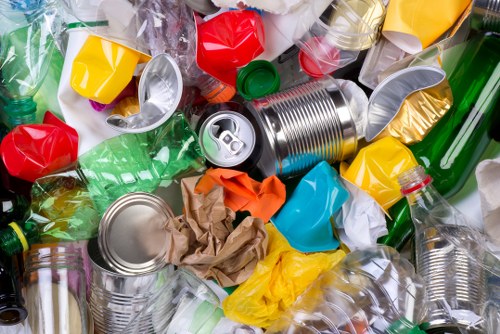 House Clearance Queens Park is built around a clear environmental commitment: to run the most eco-friendly waste disposal area service in the neighbourhood. Our Queens Park house clearance teams prioritise reuse first, recycling second and energy recovery only when unavoidable. We combine local knowledge with practical action to reduce what goes to landfill. Our goal is measurable: we aim to recycle or reuse at least 75% of all collected materials from every clearance job, turning clearances into opportunities for circular use.
We work closely with the local boroughs — including Brent and Westminster — to align our collection and sorting processes with council policies and kerbside schemes. That means matching the boroughs' approach to waste separation with clear streams for glass, paper and card, plastics and cans, kitchen food waste and textiles. By syncing with local operations our clearance services in Queens Park reduce contamination and improve the recovery value of materials we divert from residual waste.
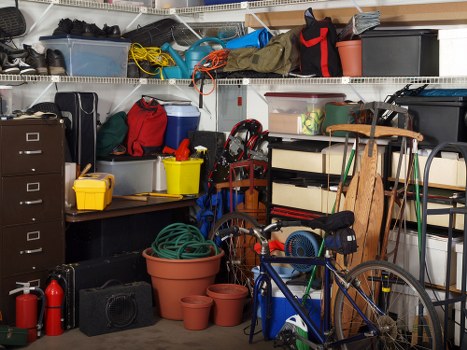 Our sustainable rubbish area strategy is practical: each house clearance in Queens Park is assessed on arrival so items that can be reused are segregated, functional furniture and appliances are inspected for donation, and hazardous materials are isolated for specialist handling. We maintain a compact on-site sorting point on every job to separate reusable goods, recyclables and waste destined for authorised transfer stations. Every step helps us approach that 75% recycling target.
We use local transfer stations and authorised facilities to keep transport distances low and ensure responsible processing. Where possible we route separated loads to West London transfer hubs and community recycling centres — including nearby transfer stations that service Queens Park and surrounding boroughs. This local routing reduces vehicle miles and speeds materials to the correct recycling streams, from metal recycling to wood and plasterboard recovery.
 Partnerships with charities and social enterprises are central to our reuse-first approach. We coordinate donations and collections with national and local charities: furniture and household items are offered to organisations such as the British Heart Foundation and Emmaus, while smaller reusable goods are channelled to community groups and local re-use centres. Our partnerships foster social value and ensure that items suitable for a second life leave the clearance chain quickly, rather than being recycled or sent to energy recovery.
To support the boroughs' waste separation regimes we provide clear guidance to customers about sorting and collection choices. Our teams carry labelled sacks and bins for easy sorting on site and document the destination of bulky items. We also cooperate with registered hazardous waste carriers when we encounter electrical waste, paints or chemicals, ensuring those materials reach compliant treatment facilities rather than contaminating loads.
Our vehicles are part of the sustainability solution: we operate a fleet of low-carbon vans including modern electric and hybrid vehicles for short urban trips and Euro 6 diesel alternatives where longer journeys are required. Low-emission vans reduce local air pollution and, when combined with route optimisation software, cut fuel use and overall carbon output. We constantly evaluate new low-carbon technologies to keep our Queens Park house clearance operations greener.
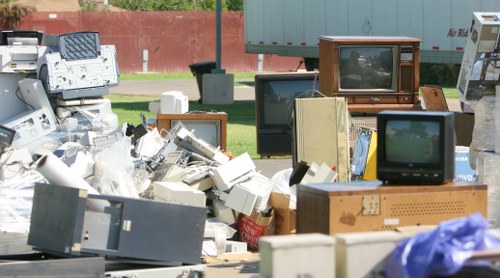 Transparency matters. For every job we provide a breakdown of the likely diversion outcomes: percentage to reuse/donation, percentage to recycling (paper, card, glass, plastics, metals, textiles), and percentage to authorised energy recovery if necessary. We publicly report progress against our recycling percentage target so clients can see how individual clearances contribute to wider sustainability goals in the area.
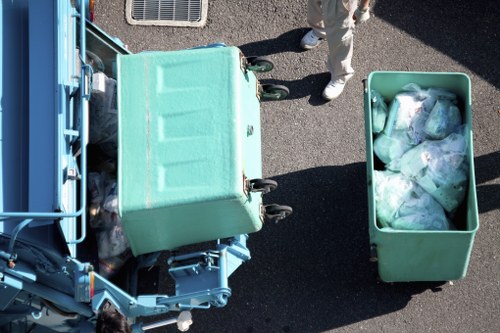
Practical recycling activities and what to expect
In practice, a typical clearance will include the following activities:- Pre-clearance assessment to identify items for donation and materials that can be recycled.
- On-site segregation where our crews separate wood, metals, glass, paper/card, textiles and food waste when required.
- Delivery to local transfer stations and reuse partners to minimise travel and maximise recovery.